Key takeaways
- Biological design, laboratory validation and industrial production are different capability systems.
- Scale-up risk comes from variability, yield, feedstock, downstream processing and quality requirements.
- AI increases the need for traceable data and rigorous experimental feedback.
- Biosafety, biosecurity and sustainability must be designed into the commercial model.
Connect digital design to experimental reality
The OECD's 2025 assessment describes a convergence of synthetic biology, AI and automation across health, agriculture and production. Models can support design and prioritization, while robotics can increase experimental throughput. The value of that loop depends on reliable data and experiments that test whether a proposed biological system performs under relevant conditions.
A commercial team should treat the model, laboratory workflow and data lineage as one learning system. Predictions need versioned inputs, experimental outcomes and criteria for deciding which result advances. Without that traceability, greater speed can create more observations without producing dependable knowledge.
- Versioned biological and experimental data
- Defined validation conditions
- Closed loop from prediction to experiment
- Human review for consequential design choices
Make scale-up the center of the business case
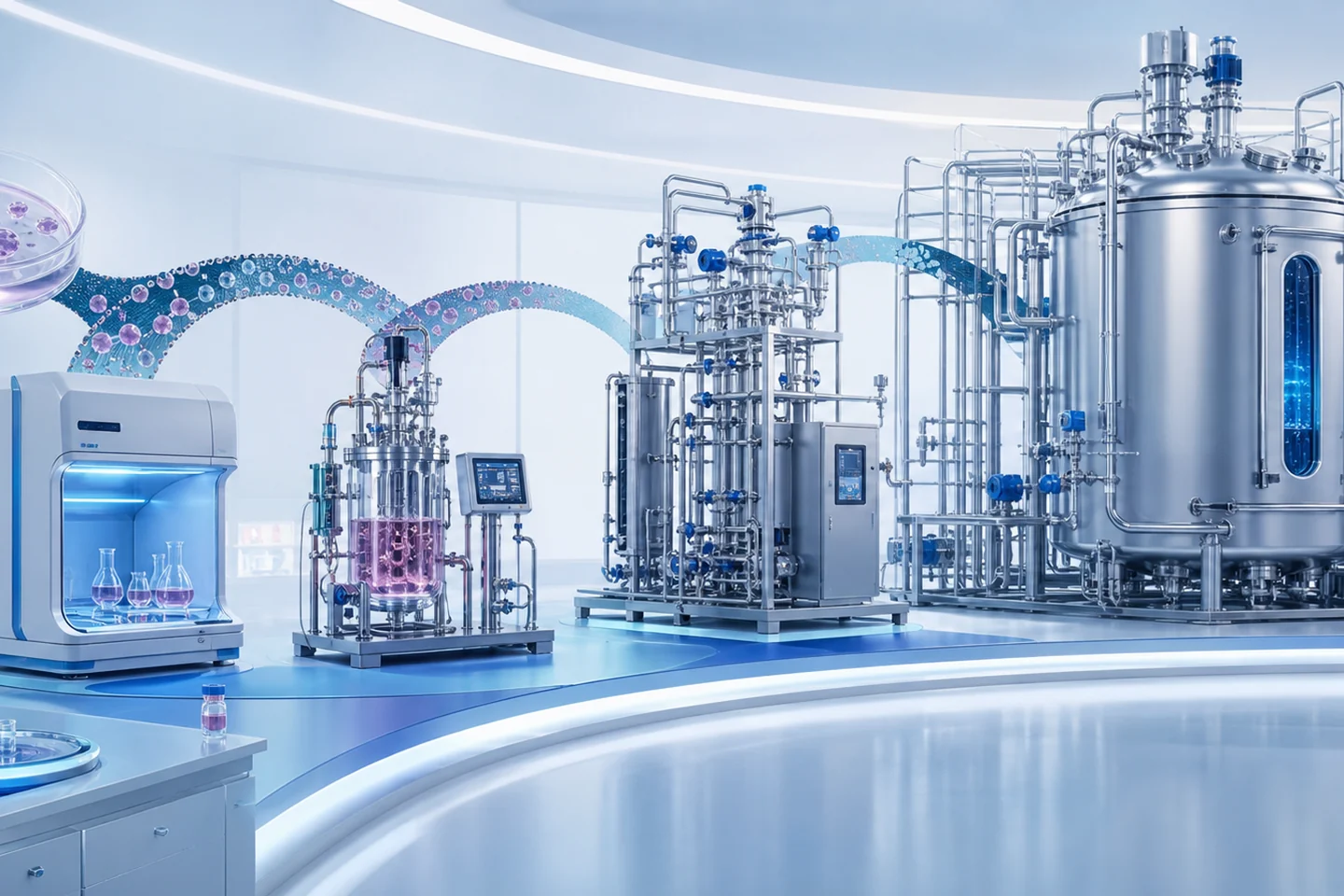
Performance in a laboratory vessel does not establish performance at industrial volume. Mixing, oxygen transfer, contamination, feedstock variability and downstream purification can change yield and cost. The production route must therefore be designed and costed alongside the biological system.
Milestones should expose those constraints early: reproducibility across runs, product quality, recovery yield, access to suitable fermentation or processing capacity and supply under realistic specifications. Partnerships can accelerate scale, but only if process knowledge and decision rights are clear.
- Reproducibility and yield across runs
- Feedstock availability and specification
- Downstream recovery and quality
- Capacity, technology transfer and process ownership
Govern safety and sustainability as product requirements
Synthetic biology can support products across chemicals, materials, food and health, but the risk profile varies by organism, application and environment. Biosafety, biosecurity, human oversight and regulatory evidence must follow that specific use rather than a generic label for the technology.
Sustainability claims also require system boundaries. A biologically derived input may reduce dependence on fossil resources while creating pressure through land, water, energy or biomass demand. A credible operating model measures those trade-offs and updates them as the process moves from pilot to commercial scale.
- Use-specific biosafety and biosecurity
- Regulatory evidence and quality management
- Lifecycle resource and emissions boundaries
- Monitoring after deployment
Build a techno-economic model that changes with evidence
The economic model should begin before the biology is finalized. It links titre, rate, yield, batch duration, feedstock price, downstream recovery, capital utilization and quality loss to the delivered cost. Each experiment then updates a variable that matters to commercial viability rather than optimizing a laboratory metric in isolation.
Sensitivity analysis identifies the assumption that deserves the next test. If recovery yield dominates cost, another round of strain optimization may create less value than a separation experiment. If capacity is scarce, a partner's transfer time and campaign availability belong in the model alongside process performance.
- Mass and energy balance
- Yield and cycle-time sensitivity
- Downstream purification burden
- Capacity and technology-transfer timing
Preserve traceability from design to released product
Commercial production needs lineage across digital design, organism or cell bank, raw materials, experimental protocol, process batch and quality result. That chain supports troubleshooting, regulatory evidence, reproducibility and control of intellectual property. It also helps isolate whether a performance change came from biology, equipment, material or data processing.
Governance should define access to sequence and process data, review of dual-use concerns, containment, incident response and responsible disclosure. These controls are part of the operating system, not documentation to add after scale has been achieved.
Evidence ledger
Commercialization analysis based on OECD work on biotechnology, synthetic biology, AI and automation. It separates laboratory evidence, production economics, regulation and lifecycle sustainability.
OECD analysis describes convergence among synthetic biology, AI and automation while emphasizing governance and responsible development.
Bioeconomy commercialization depends on production systems, policy and sustainability outcomes, not discovery science alone.