Key takeaways
- Safety is a property of the complete application, not a robot model in isolation.
- Task variation and human exceptions must be included before a pilot is described as production-ready.
- Software and model updates need the same change-control discipline as physical modifications.
Define the application boundary
The same robot can create different risks when payload, tooling, speed, layout, materials or human interaction changes. The assessment must describe the real application and environment.
General-purpose or learning systems add uncertainty because behavior can vary with perception and software. Their allowed operating envelope should be explicit and technically enforced where possible.
- Task, payload, tooling and energy sources
- People who enter or work near the space
- Normal, degraded and maintenance modes
- Environmental conditions and foreseeable misuse
Design controls as a system
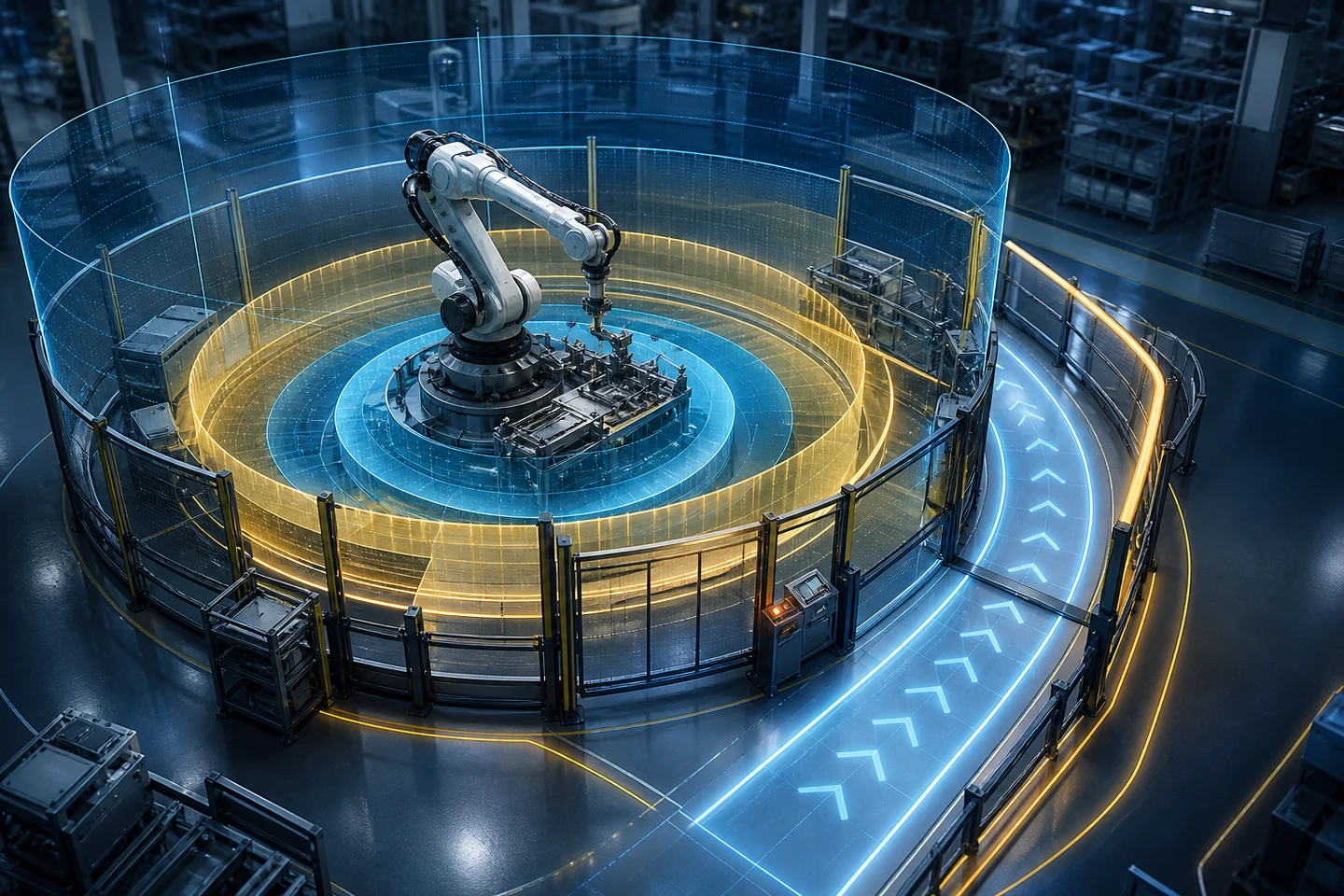
Protective devices, speed limits and stops are only part of the control system. Work instructions, access, supervision, training and maintenance determine whether the technical safeguards remain effective.
A layered design assumes individual controls can fail. It also makes the residual risk and owner visible rather than hiding it behind a supplier certification.
- Physical separation or validated collaborative limits
- Safe states and recovery after interruption
- Authentication for configuration and maintenance
- Human-readable status and emergency action
- Inspection and proof-test intervals
Control learning and change
Software, perception models and task policies can materially change behavior without a physical modification. Updates need versioning, regression evidence and approval proportional to the possible consequence.
Near misses and manual interventions are valuable evidence. Recording them in a low-friction way helps engineering teams expand the evaluation set before the same condition becomes an incident.
- Version software, models, policies and configuration.
- Revalidate affected hazards before release.
- Monitor interventions, stops and unexpected motion.
- Define rollback and isolation procedures.
Validate the integrated application, not the robot alone
A compliant robot component does not make the finished cell safe. The risk emerges from tooling, payload, speed, layout, stored energy, material flow, software behavior and the ways people enter the area to load, recover or maintain it. The integrator and operator need a documented view of the complete application and its reasonably foreseeable misuse.
Validation should confirm that protective measures perform under real operating states: startup, automatic production, manual teaching, jam recovery, cleaning, maintenance and loss of utilities. Evidence includes measurements, functional tests, inspection and confirmation that instructions match what workers actually do.
- End effector and workpiece hazards
- Access during normal and abnormal states
- Safe stopping and energy isolation
- Validated recovery procedures
Make every change a controlled safety event
Robotic applications evolve after commissioning. A new product, gripper, speed, vision model, route or software update can invalidate assumptions in the original assessment. Change control should identify which hazards, limits and protective functions are affected, then require proportionate testing before release.
Near misses and repeated interventions are leading indicators. Recording why people enter the safeguarded space, defeat a routine or reset the cell can reveal design problems before an injury occurs. The best safety improvement often removes the operational reason for unsafe behavior rather than adding another warning.
- Versioned configuration baseline
- Safety review tied to change tickets
- Intervention and near-miss analysis
- Training updated with the actual process
Evidence ledger
Safety-oriented operating guidance informed by the 2025 ISO 10218 robotics standards overview, NIST manufacturing research and sector deployment evidence. It is not a substitute for a site-specific risk assessment by qualified professionals.
ISO 10218 separates requirements for industrial robots from requirements for robot applications and cells, reinforcing the need to evaluate the integrated system.
Manufacturing robot safety depends on the application, human interaction and lifecycle changes, not hardware certification alone.